
I think best when I write. I believe it to be true for others, too.
Suppose the premise that penned thoughts are the best is correct and that the adage, the pen is mightier than the sword, accurate; then reading becomes the act of defiance against the protracted colonisation of our fossilised minds.
Bob Marley spoke the truth; we must emancipate ourselves from mental slavery.
Nothing gives one’s life more colour than having a good and diverse diet of literature. And instead of seeing the world in monochrome or black and white, eclectic book consumption equips us with a lens through which we can see a colourful and vibrant world and often more honestly. But we also need wide eyes to experience and understand life’s kaleidoscope and glimpse its nuance, which diverse reading supplies, enlarging our aperture and allowing the light we desperately need into our otherwise grey and narrow perspectives.
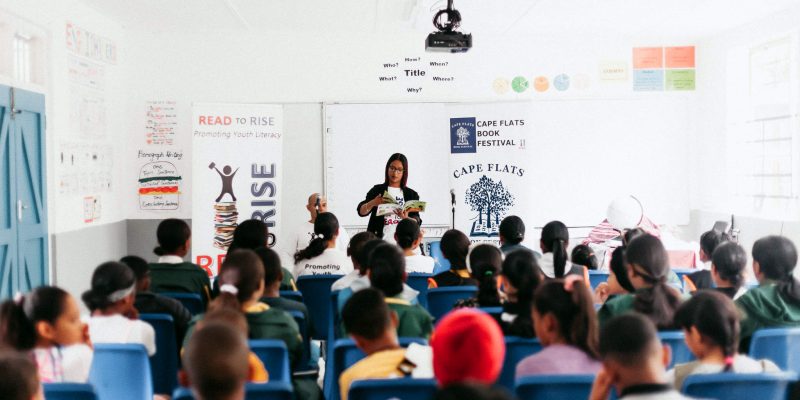
Many communities of colour often feel dislocated from mainstream literary events. The Cape Flats Book Festival held in Mitchell’s Plain aims to change this. Organised by Read to Rise, their incredible work flies in the face of the commercial and political interests that often drive these elitist events. Athol Williams and his Read to Rise team deserve the highest praise for their service.
We enter a sacred realm when coupling sincere intentions with a desire to serve those less fortunate. We further elevate its sanctity when the service imparts knowledge, wisdom, and hope. These virtues are the engine that drives the festival. The space is indeed sacred, and it moved me deeply. My experiences over the festival weekend were profoundly spiritual.
Many highlights, too numerous to cite, were bookended by a conversation with an Anglican priest and an unrehearsed exchange with three extraordinary women (actresses and poets) that brought down the curtain on the festival.
I fail to remember the priest’s name, but we reminisced about a time when our communities knew each other intimately, regardless of faith, culture, or persuasion. There existed a unity irrespective of differences—a togetherness bound by love, understanding, respect, and a shared concern for all. He grew up in Bo Kaap and related, with much nostalgia, when the students at St. Paul’s Primary, the Catholic School, used to attend Friday mass at the cathedral, followed by the Muslim Friday congregational prayers at the mosque. I could relate because my Muslim cousins, too, schooled at St. Paul’s. He then recounted, with much tenderness, love, and deep gratitude, the story of Aunty Raggie, a Muslim neighbour. She had gleaned knowledge about his family’s plight and decided to do something that would forever impress his heart. They were poor, and he only got new clothing once a year at Christmas. But one particular year, his parents could not afford to buy him his Christmas best. Aunty Raggie made arrangements, fetched the young lad, and took him Christmas shopping. He told me that he still remembers her every day for the love and humanity she showed him.
Inspiration was abundant, thanks to Williams and his wife, Taryn Lock, for curating a fantastic lineup.
The poetry and the spoken word poets were otherworldly. Their words were jarring and settled deep, like cancer, but of the curative type, regenerative and healing.
The authors were world-class and enthralled those who came to listen, many of whom would never have had the opportunity to share such a space were it not for this literary festival.
Mitchell’s Plain and the habitations of some of the presenting authors may just as well be on different planets, though only separated by tens or more kilometres.
Roscoe Williams, brother of Athol, shared that many aunties could not believe that the author sessions were free and requested his confirmation. Unfortunately, many locals feel like impostors, that they don’t belong because the types of engagements at literary festivals are outside Mitchell’s Plain’s paradigm.
We must back The Cape Flats Book Festival to create a space that bestows this shift upon all our disenfranchised communities.
Red Kufi Books exhibited and presented two sessions at the festival: Why Read-The Importance of Being Well Read, and Self-Publishing. The former session closed with the published poet Janine Overmeyer, who goes by the stage name, Blaq Pearl, reading the poem Television by the author Roald Dahl. We didn’t plan for it, but our 14-year-old son, scheduled to do the reading, couldn’t be present, and Janine kindly obliged to fill in when asked at the 13th hour. This type of selflessness is the currency of change and was at the festival’s heart.
Aunty Fadeela, a kindly stranger and patron at our exhibition, too exhibited the same virtue. She offered to help us in an hour of need when we were light of hands and needed cover at our stand. Selflessness without a desire for reciprocity is a rarity and, therefore, so noticeable when presented. It is this public spiritedness that animates The Cape Flats Book Festival.

A passionate poetry recital by the acclaimed poet, writer, activist and actress Khadija Heeger [Photo by Roscoe Williams via The Cape Flats Book Festival]
Good poets move us, but the exceptional ones are social scientists, capable of deciphering the past and projecting the future. Khadija Heeger is one such poet, a herald with a powerful voice that provokes an ear, mind, and conscience. Her book Thicker than Sorrows is a collection of poems that do just that.
I made Khadija’s acquaintance at the festival after her friend, Jill Levenberg, the award-winning actress from the South African drama film: The Ellen Pakies Story (a must-see), and the Suidooste soapie visited our stand. She greeted me and thanked me for supporting the festival. And I returned her greeting as if I knew her. Who’s this woman: I thought, and why do I always forget people’s names? But know her, I did not. Her beautiful personality and spontaneity in connecting with others made me think that. She warmly spoke of Khadija and her pedigree as a poet. Khadija was about to perform and share the stage with a fellow poet, Gaireyah Fredericks, whom I had met earlier, and who shared an impromptu reading of a poem she had penned about the Prophet Muhammad (peace be upon him).
Khadija took the stage, and I took a seat in the same row but several seats away from Jill. I was immediately captivated and reduced to tears when Khadija took a bow. I looked at Jill in recognition of the truth she’d spoken: Khadija is a genius.
It was a hard act to follow, but Gaireyah stepped up and expertly moved the crowd with her inspiriting words just as a breeze gently casts many sails homebound. And home we were, bathed in our tongues by mothers of our ilk.

Writer, Zaahied Sallie & actress, Jill Levenberg
Many moments later, Jill, Khadija and Gaireyah found their way to our stand and, with my wife, Nurah Tape, and I, we enjoyed good conversation with much merriment. Jill formally introduced herself, and after discovering that we don’t own a TV, she tried to convince me to download a viewing app and start watching Suidooster from the start. “It is important that you do, Zaahied. I play Mymoena, the first Muslim matriarch to grace the South African small screen.” They discovered that Nurah and I were writers and glimpsed a copy of my latest book. We spoke of the craft and lived experiences.
During our engagement, the humility and humanity of these strong women struck me. There was no self-seeking. Like a book, they were comfortable in their skin and happy in their story.
Many may think the Cape Flats a literary desert. However, the people at Read to Rise speak of her as an oasis, ready to cull emerging writers, like the Heegers, Fredericks and Levenbergs, to tell her stories.

| There are no products |