

THE FIRST COMMANDMENT
Many are familiar with the Ten Commandments, which arise from Judeo-Christian ethics, beginning with “You shall have no other gods before Me.”
But how many people know about Islam’s First Commandment? I would argue that not many non-Muslims do.
It’s tinsel season, and while browsing one of South Africa’s most popular book chains, I engaged the branch manager about their Islamic literature offering. She was polite, and we had an engaging conversation.
I asked her what the first of the Ten Commandments was, as a lead-in to my second question: “What is Islam’s First Commandment?”
She incorrectly answered my first question, and the second one stumped her. I don’t think she had ever pondered my query. To her credit, not many have, Muslims included.
My answer wowed her. Never in her wildest dreams did she expect that Islam held reading in such high esteem.
So, I’ve decided to trademark the following line: The First Commandment: Read! [96:1]
Maybe next year, she will use the trademark line along with her tinsel decor and advertisements in the store window. Just maybe.
And just maybe, we will trademark it onto our hearts.
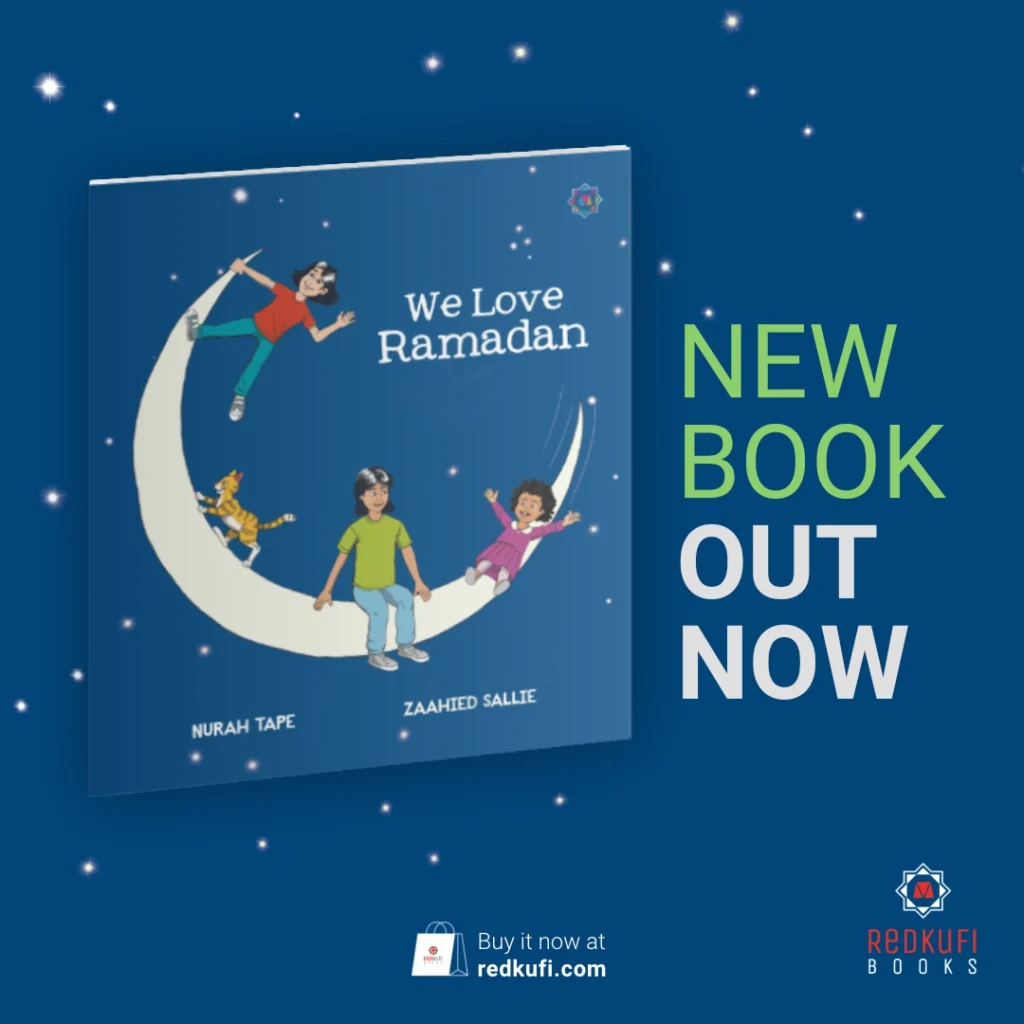
We Love Ramadan
by: Zaahied Sallie, Nurah Tape-Sallie,
We Love Ramadan is a delightful tale about how the spirit of Ramadan captures the hearts of three siblings and sets them on a Ramadan adventure until the special day of Eid arrives!
THE GREATEST INTRODUCTION
Located in the mountain’s throat resided a heart deliberately withdrawn from the city. A heart desperately seeking the Transcendent, yet unprepared for that fateful, heartwrenching introduction. Yet, no heart could have been more ready than Muhammad’s was on that day. So, God took His beloved’s heart and wrapped it in an unfolding Book more tenderly than any mother ever could, and sparked a 23-year literary communion that would forever change the world.
Allah’s first introduction to the Prophet (s), and us by extension, is in the opening verse of Surah al-Alaq, chapter 96.
With literary brilliance, Allah inaugurated the first commandment, then made it sublime.
Allah said to Muhammad (s), Iqra’ bismi rabbik. Read, in the name of your Lord.
Why didn’t Allah say, Iqra’ bismillah?
To answer this, we need to examine the name Allah, its meaning, and the feelings it evokes.
The etymology of the word Allah, known as lafdh al-jalalah (the designation of majesty), is a cognate of the word al lā ha, meaning to be startled and baffled. Allah’s Indivisible Nature, Uniqueness, and Majesty bewilders the limited capacity of the intellect and perplexes the human being. The more we try to understand Allah, the more He eludes our grasp.
The name Allah has quwwa (power) and evokes awe. So, instead, Allah introduces Himself to the Prophet (s) as Rabbik. Allah does this because the Prophet (s) was terrified. Gabriel’s embrace was real, not imaginary, and the Prophet (s) would later relate that it was as if his life was leaving him.
After the third embrace, Gabriel said to the Prophet: Iqra’ bismi rabbik, Read in the name of your Lord. Allah also did not say Iqra’ bismi rabb, Read in the name of the Lord.
The scholars of tafsir (exegesis) say Allah did this for three reasons:
1. To calm the Prophet (s). Rabb denotes Nurturer, Cherisher, Sustainer, and Protector.
2. To honour the Prophet (s). Rabbik means Your Lord, indicating a personal relationship.
3. To strengthen the Prophet (s). The opening address infers that the Prophet’s mission will be arduous, but that his Rabb is with him.
Secondly, Allah chose to introduce Himself as the Khaliq, the Creator. Allah wanted to settle the Prophet (s) even more and increase his steadfastness. Khalaq is one of the attributes of Rabb. Naturally, people fear creation. So, Allah informed the Prophet (s) that his Rabb is also the Khalaq, so fear not.
Another reason for Allah choosing the name Khalaq is that it leads to nature’s signposts, which direct us to Allah.
Khalaq is a transitive verb and requires an object. But there’s no object in the verse. Read in the name of your Lord who created.
Created what?
When something is missing in the Quran, scholars say it is to bring about a universal. Allah is the Creator of everything, so everything points to Him.
In the first verse of Revelation, Allah connects everything you see to Him and reveals Himself through your eyes.
It is also to bring the listener into the narrative.
For example: Read in the name of your Lord who created my mother, or my children, or the mountain, or whatever object you wish to insert.
Allah is also the Musabbib, the Creator of all causes.
The universal creates benefit, which is the purpose of the Quran. It is to bring us closer to Allah by guiding us to His signposts. Without the object, the Quran widens the possibilities of thikr (remembrance) and tafakkur (reflection).
Thirdly, Allah introduced Himself as the Karim (The Most Generous), indicating that our relationship with our Rabb, the Khaliq, which we can develop through reading, is one of His most favoured bounties.
A key ingredient to forging a new, better, happier, and more reflective you is one word at a time. When you enfold yourself in books, they become like garments, embellishing every piece of you. They also become the engines driving your behaviour. Some are powerful. Others not so.
Regardless, nothing gives one’s life more colour than having a good and diverse diet of literature. And instead of seeing the world in monochrome or black and white, eclectic book consumption equips us with a lens through which we can see a colourful and vibrant world and often more honestly. But we also need wide eyes to experience and understand life’s kaleidoscope and glimpse its nuance. Diverse reading offers us this, enlarging our aperture and allowing the light we desperately need into our otherwise grey and narrow perspectives.
So, raise 2026 by submitting to Islam’s First Commandment: Read!
Below are 51 of my favourite books:
My wish is that you end 2025 with a book, and begin 2026 with one, too, InshaAllah.


Until next week, InshaAllah
P.S. Remember to write weekly to the President
Zaahied Sallie
Author of The Beloved Prophet – An Illustrated Biography in Rhyme
Thanks for reading. Every Friday, I share thoughts and ideas to help cultivate the link between Allah, the Prophet and me (meaning YOU). Enter your email now and become part of the link.

| There are no products |