
-

Zaahied Sallie, Nurah Tape-Sallie,


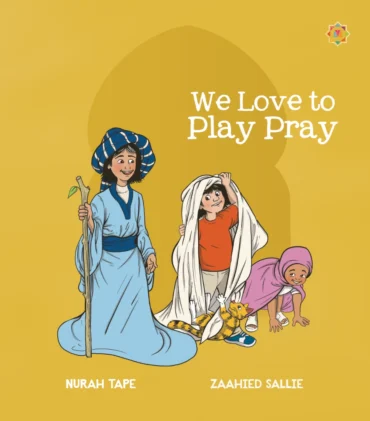
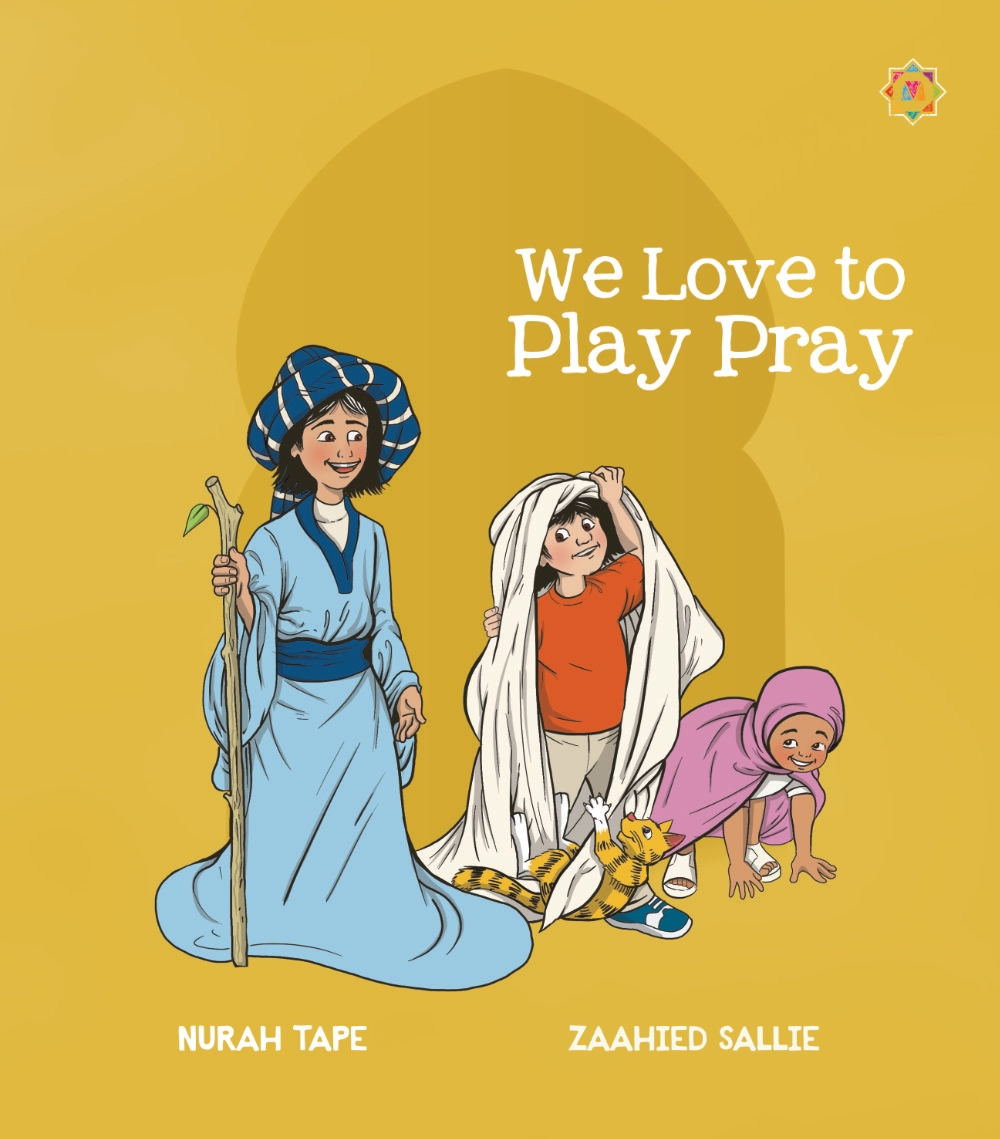
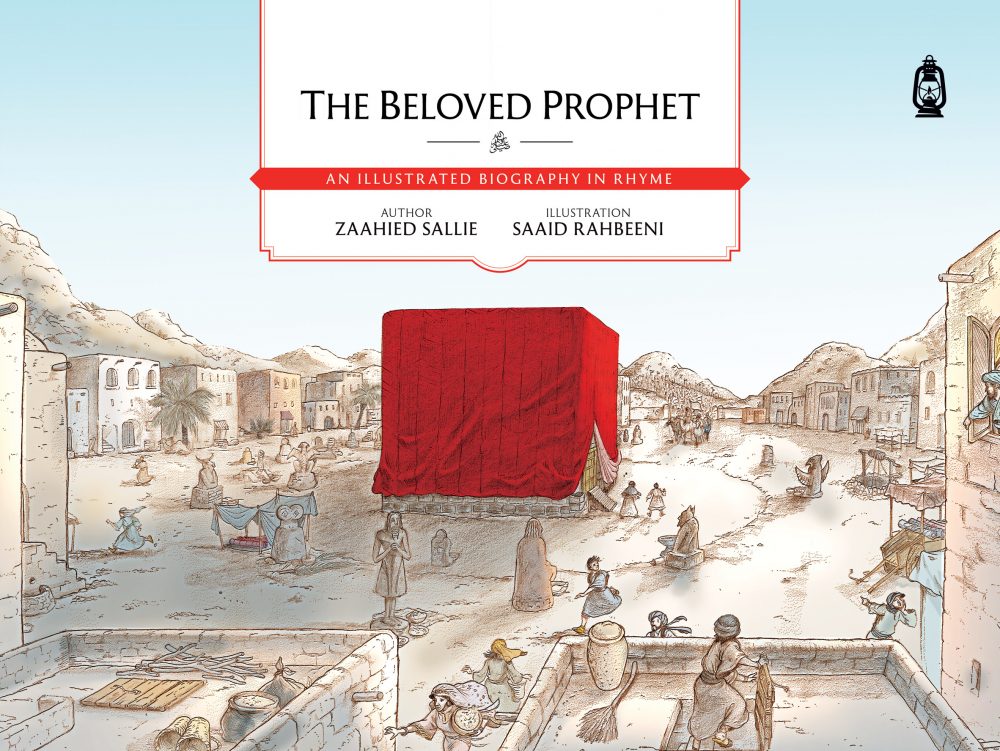
We Love to Play Pray
by: Zaahied Sallie, Nurah Tape-Sallie,Second Edition
A colourful story of three siblings who combine their love for playing with praying. In turn, they learn about the qiblah and how the sun and shadows help them determine prayer times.
Original price was: R220.00.R190.00Current price is: R190.00.




Let’s Play
A colourful story of three siblings who combine their love for playing with praying.
Let’s Pray
In turn, they learn about the qiblah and how the sun and shadows help them determine the times for prayer.
Let’s Play Pray
ISBN: 978-1-049-24730-4
Publisher: Red Kufi Books
Publish Date: 2026
Page Count: 28
First Edition: Since we received it, we have been reading it over and over again - and the little ones already know the words! So much information presented in such an amazing way." Razeena Gutta, Author of the acclaimed Ahmed and Fatima Series and founder of Read Little Muslims, Australia, Brisbane. We love to Play Pray is a delightful read. It provides you with a glimpse into a child’s playful imaginary world and thus will appeal to any young reader. It is an excellent book to use by a parent/educator as a basic introduction to Salaah as it provides useful information on the five daily prayers, without being too pedantic. It comes highly recommended ... We love to Play Pray is a must in every home and school library." Saleema Dawood, Early Childhood Development Practitioner and Writer, Cape Town, South Africa.
“We Love to Play Pray”
-
Sale!Living Where We Don’t Make The Rules Original price was: R330.00.R300.00Current price is: R300.00.
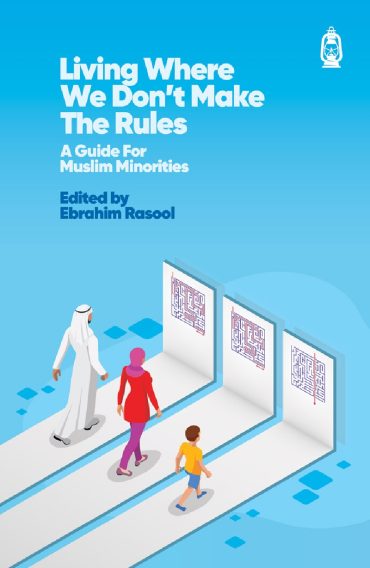
This work operates from the premise that today, 90 percent of countries worldwide have significant minorities that constitute at least ten percent of their populations. One in four Muslims lives in minority situations in almost every part of the world. Some have assimilated and forfeited their practices and identities in order to ‘belong’ while others have isolated themselves with others who share their language, national origin, culture or religion. But there are also Muslims who have been able to manage both their Islamic identity and other elements of identity that come with their new places of residence.
Living Where We Don’t Make the Rules is a guide that in pursuing the third option — balances theoretical rigour with practical direction. It includes the lived experience of those on the forefront of living as minorities, but also the scholarship of those who apply the synthesis of Islam’s timeless values, norms and principles, with the exigencies of the frontiers where Muslims find themselves in. It provides leadership that can guide everyday life, manage our faith, direct partnerships with fellow citizens and campaigns for inclusivity.
-
A Journey Through the World of Belief R139.00
Monotheism (Tauhid)—the Oneness of God (Allah)—is the very essence of Islam, encompassing the Muslim’s core belief system.
This 377-page book explores, investigates and details the concept of Islamic monotheism: What God can and cannot be, that which is impossible and permissible on Him, His undisputed attributes and Inner-Self, how to know God, and the Universe’s genesis.
The book further investigates why Allah’s existence is wajib, the concept of iman (faith) and what it means, how man’s actions affect his reward and retribution in this world and the after-life. Deeper universal subjects that still perplex mankind such as Qada and Qadr (fate and destiny) are also explored – from an Islamic perspective. This extensive study, which also details the historical background to the rise of certain sects in Islam and their belief systems, such as the Shia, Khawarij, Asha-‘irah and Mu’tazilites is certified and endorsed by the al-Azhar University in Cairo, Egypt, for its clarity of content.
An easy to follow glossary makes this, yet another publication by Shaikh Abdurraghiem Hasan Sallie, appealing to readers across denominations.
Excerpt
“This science is wajib (necessary) for every male and female to study. It is also the duty of every parent, teacher and spiritual guide, to ensure that children are taught this science so that they would be able to base their principles of life on the tenets of tauhid. Tauhid should be taught at the level of comprehension and perception of the child and student. Naturally, the degree of difficulty of the subject matter will be taught at the level of the individual’s mental development. This must be the most important issue in every Muslim’s life and in every Muslim home. It is more important than salah, hajj, fasting and all other forms of worship because no act of worship is accepted by Allah if we have false beliefs that result due to lack of tauhid.” -
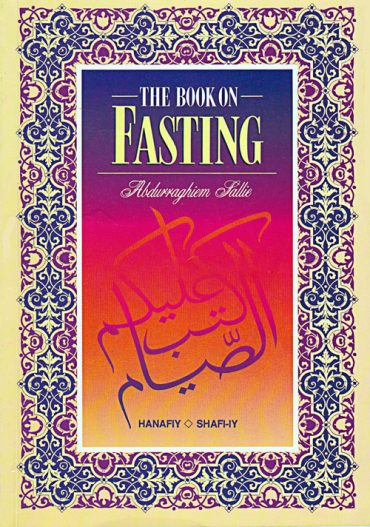
The Book on Fasting R74.00
Fasting is one of the most meritorious acts in Islam. In this book the fiqh (jurisprudence) of fasting, as well as its excellence, virtues and benefits, are expounded upon, which will if read and understood, enhance the observance of fasting to a higher degree, Insha-Allah.
The definitions of fasting, the various types of fasting and its principles and rules are defined. The sighting of the crescent, the manner in which the months of Ramadan and Shawwal becomes official, the viewpoint of the astronomer and the Hakim (judge) are discussed.
Other interesting discussions include fasting on Youmush Shak (the day of doubt), the various viewpoints of Laylatul Qadr, the fifteenth night of Sha’ban (Laylatul Bara-’ah – the night of pardoning of sons), and the days when fasting becomes haram (unlawful), makruh (abominable) and sunnah (recommended).
Fasting during the early days of Islam, actions which nullify the fast such as eating and sexual intercourse as well as the kafarah (atonement) for the transgression are explored. Reasons which make eating permissible during Ramadan and its judgement are discussed with a valuable addition to the book on pregnancy and breast-feeding. A medical perspective on fasting which answers popular questions on fasting has also been added. I’tikaf (intention to remain in a mosque to perform certain actions), Tarawih salah, Eid Salah, the Takbirs and actions sunnah to perform on the day of Eid are explained in detail. The Zakatul Fitr and voluntary sadaqah are expounded upon.
This book has been written from the viewpoints of the Shafi’i and Hanafiyah schools of thought.
Excerpt
Fasting regularly removes the screen that thwarts us from reaching greater and higher spiritual levels. If we look around us, we will find countless people indulging in their every desire and greed. Their greed for wealth, for example, causes a barrier between them and what is honourable. Others overtax their bodies by indulging in everything that arouses their appetite.
How appropriate the statement of some of the sahabah (companions) who said: “Man has not filled a container worse than his stomach.” Jesus used to say to his disciples: “Do not eat much, otherwise you will drink much and your hearts will become hard.”
-
Sponsor-a-Book R0.00At Red Kufi Books, our mission is simple: to remind Muslims of the very first Qur’anic command – Iqra. Read – which was revealed on Laylatul Qadr – the Night of Power – the greatest night of the year.You can help Red Kufi Books gift copies of We Love Ramadan and We Love to Play Pray, two delightful children’s picture books, to schools and madaris.These two books are the first in our ‘Five Pillars’ series, and they introduce the Five Pillars of Islam in a gentle, fun, and organic way. These books also serve to educate cross-culturally and build bridges between children of different faith communities.Many children in South Africa have never owned a storybook. And we aim to change that — one book at a time.You can support our efforts by sponsoring one, five, ten, or more copies at a special reduced rateGet in touch with us today via WhatsApp on 060 8803776 or email us at iqra@redkufi.com
-
The Evolution of Islamic Legislation R389.90
Islam was revealed at a time when the Arabian Peninsula was in a state of social anarchy. The legislation on which Islam is built transformed this hedonistic pagan society into one based on social justice and morality of the highest order, with tauhid (monotheism) as its fundamental principle.
This study traces the evolution of Islamic legislation (the shari’ah) through six periods. In this volume, the first three periods are explored, from the first revelation by Allah of the Holy Qur’an to Prophet Muhammad, peace be upon him, until his death. Then the rule under the four rightly guided caliphs – Abu Bakr, Umar, Uthman and Aliy (may Allah be pleased with them). And finally, the period of the scholars among the successors of the companions of the Prophet known as the Tabi-’in.
Volume two covers the remaining three periods; that of the four famous imams namely; Abu Hanifah, Malik, Shafi-’iy and Ahmad bin Hambal. They later developed the four major schools of thought in Islam. This era is known as the Golden period of the Islamic legislation since the caliphs granted leeway to those scholars who were qualified to resort to ijtihad (research).
An insight is provided for the establishment of the shari’ah and the various factors considered when the legislation was formulated. Verses expounding peace treaties and the fate of prisoners of war are discussed. The rules of war, the protection of women and children and the elderly are discussed in detail.
The first period focuses on the divine revelation (the Holy Qur’an), the reasons for its intermittent revelation over a period of nearly 23 years, the Meccan and Medinan periods and its explication by Prophet Muhammad.
The second and third periods explore the impact of the rule of the four caliphs on the development of the Islamic Legislation, as well as the introduction of analogical deductions and consensus among the scholars among the Companions, their successors and later scholars. The history of the compilation of the Holy Qur’an into book form and the establishment of the science of sayings and actions of Prophet Muhammad are clearly illustrated.
The rise of various sects in Islam and their influence on the shari’ah are further explored as well as the emergence of fabricators of prophetic traditions.
Excerpt
ISLAMIC LEGISLATION (TASHRI‘ AL ’ISLAMIY)
The Arabic word Tashri’ is derived from the root word shara’a which means “legislation or to legislate.” In terms of this subject, it infers ” to legislate”. It also infers to establish or discover principles/ rules, the systematic arrangement of rules, the elucidation and presentation of decrees (ahkams) at a level that could be comprehended by the masses and thereby serve as a guide to enhance their spirituality and beliefs. In addition, the word shara’a also means:
A waterhole where animals drink. The following example conveys the meaning in context. “The camels drank when they were led to the watering hole/place.”
A straight path. The holy Qur’an also refers to this type of meaning: “After this we have placed you on a straight path (of ethics), follow it and do not follow the desires of those unknown to you”. Al-Jathiyah, 45:18




There are no reviews yet.